Many Boston businesses are proudly promoting their sustainability initiatives. Recycling programs, eco-friendly supplies, and ESG commitments have become standard aspects of today’s workplace operations.
But what if some of the biggest environmental problems in your facility aren’t visible?
The reality is that it’s not just about what your organization is doing. Most environmental issues hide in daily cleaning routines, waste management, outdated equipment, and employee behaviors that quietly undermine even the most well-intentioned sustainability efforts.
The result is companies pouring money into looking sustainable while unknowingly creating waste, inefficiency, and credibility gaps.
Here are 5 costly sustainability mistakes Boston businesses continue to make and how to avoid them.
-
Focusing on Green Products While Ignoring Green Processes
One of the most common mistakes is assuming that purchasing environmentally friendly products automatically creates an environmentally responsible workplace. While green cleaning products are important, they represent only one piece of the sustainability puzzle.
So, what makes a cleaning program truly eco-friendly and sustainable?
It’s not just the label on the bottle. A facility can use the most expensive, certified green chemistry available and still be unsustainable. Why? Because how you clean often has a bigger environmental impact than what you clean with.
Consider these hidden inefficiencies:
- Overuse of chemicals: Staff following outdated protocols may use two or three times the necessary dilution, flushing excess surfactants and preservatives into the water system.
- Excessive water consumption: Mopping techniques that require repeated rinsing or inefficient auto-scrubbers waste thousands of gallons annually.
- Inefficient cleaning routines: Cleaning the same zone twice, unnecessary supply stocking, or redundant passes on surfaces all burn labor, product, and energy.
- Unnecessary supply usage: Using disposable wipes where reusable microfiber would work, or discarding partially used bottles, creates waste that negates any “green” product claim.
Using green cleaning products inefficiently is not a sustainable solution. The most effective commercial cleaning programs in Boston start with process optimization and then layer in responsible chemistry to maximize the impact of green cleaning.
-
Measuring Recycling Efforts Instead of Waste Reduction
Is recycling enough to make an office sustainable? No. Recycling helps, but waste reduction has a much greater environmental impact.
So, how can businesses reduce waste without sacrificing cleanliness?
First, ask yourself: Do you celebrate how much you recycle, or how little you throw away in the first place?
The most sustainable waste is the waste that never gets created. Yet many Boston offices track recycling tonnage as a badge of honor while ignoring upstream reduction opportunities.
Common examples of unnecessary waste sources include:
- Disposable cleaning supplies
- Excess packaging materials
- Single-use workplace products
- Unnecessary supply consumption
- Inefficient ordering practices
Organizations often focus on managing waste after it exists rather than preventing waste creation.
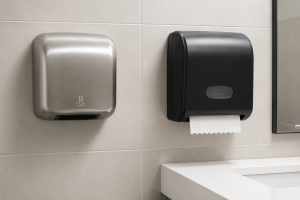
For example, reducing paper towel usage through more efficient dispensers may have a larger environmental impact than simply recycling paper waste. Similarly, purchasing concentrated cleaning products can reduce packaging waste while lowering transportation-related emissions.
Ultimately, a genuine sustainability program measures source reduction, not just diversion rates. Before your next contract with office cleaning services in Boston renews, ask whether your provider tracks consumables used per square foot. If they don’t, you’re likely rewarding volume over efficiency.
-
Overlooking Restroom and Breakroom Waste
Restrooms and breakrooms are often the largest source of avoidable waste inside office buildings, and the least audited.
Why?
Because they feel mundane. But small inefficiencies multiplied across hundreds of daily uses add up fast:
- Excessive paper towel waste
- Disposable cups and utensils
- Unnecessary product replacement
Even organizations with strong sustainability initiatives frequently underestimate the environmental impact of these spaces.
This is where day porter services become a hidden lever for sustainability. Day porters offer more than just tidiness. They monitor usage patterns, adjust dispenser settings, flag overconsumption, and consolidate waste streams in real time. Without that eyes-on feedback loop, restrooms run on autopilot, wasting money and material.
For organizations investing in office cleaning Boston solutions, evaluating restroom and breakroom waste can reveal opportunities for immediate improvement.
-
Ignoring Equipment Efficiency
Energy accounts for roughly 73% of global greenhouse gas emissions, with buildings contributing about 17%. Yet many sustainability programs focus on supplies while overlooking the equipment used every day. That’s a critical blind spot. Cleaning equipment alone can significantly impact a facility’s environmental footprint, for better or worse.
Outdated or poorly specified equipment creates three forms of waste:
- Energy waste: Older vacuums without high-efficiency motors can use two to three times more power than modern certified units. One inefficient backpack vacuum operating four hours daily can add hundreds of unnecessary kWh annually.
- Water waste: Traditional floor scrubbers may use 10+ gallons per hour, while newer eco-designed models use as little as one gallon with recycling systems that filter and reuse water.
- Chemical waste: Without precise dilution controls, staff tend to overuse cleaning agents. Similarly, equipment that relies on single-use pads also increases landfill waste compared to reusable microfiber systems.
Most facility managers overlook this because they assume “it works, so it’s fine.” But an operational assets review (vacuum motors, burnishers, autoscrubbers, even trash compactors) typically reveals energy and water savings without compromising cleanliness.
In fact, research suggests that improvements in workplace energy efficiency can reduce annual energy costs by up to 25%. A qualified Boston cleaning company will audit equipment as part of your sustainability roadmap.
-
Treating Sustainability as a Project Instead of a Culture
Another expensive mistake facility managers often overlook is treating sustainability as a one-time initiative, LEED certification push, a green product switch, an Earth Day event, rather than embedding it into daily operations.
But true sustainability goes beyond adopting eco-friendly products and technologies. It becomes a deeply ingrained concept or part of how an organization operates, influencing decisions, behaviors, and processes.
The most sustainable facilities build environmental responsibility into every aspect of their operations:
- Employee behavior: Do staff know which bins are for landfill, recycling or compost? Are they trained to report leaks, overflows, or wasteful practices? Without culture, even the best infrastructure fails.
- Vendor accountability: Does your Boston janitorial service provider offer monthly sustainability metrics? Do they proactively suggest waste-reduction changes, or wait for you to ask?
- Cleaning protocols: Are zone frequencies optimized to need rather than habit? Is there a documented process for adjusting supply usage when occupancy drops?
- Continuous improvement: Who owns your sustainability data? When waste increases, is there a root-cause review?
A sustainability program can’t succeed if only one of your departments is responsible for it. Environmental performance must become part of organizational culture.
When sustainability becomes a shared responsibility, it evolves from a temporary initiative into a lasting operational advantage, one that can withstand staff turnover, vendor changes, and shifting budgets.
What Truly Sustainable Cleaning Looks Like
If the five mistakes above define what not to do, here is the positive framework. A genuinely sustainable cleaning program includes four interdependent layers:
People – Staff trained not just in safety and chemistry, but in waste reduction, equipment efficiency, and daily decision-making for sustainability.
Processes – Optimized zone routing, just-in-time supply replenishment, documented water/energy conservation steps, and real-time feedback loops from day porter teams.
Products – Environmentally responsible supplies that are concentrated, low-VOC, and packaged in recyclable or minimal materials—deployed only as needed.
Performance – Measurable outcomes tracked monthly: consumable cost per square foot, energy use per cleaning hour, water consumption, and waste diversion rates. What gets measured gets improved.
The Role of Professional Cleaning Partners
No office manager or facilities leader can build this alone. That’s why experienced commercial cleaning services in Boston are increasingly viewed as strategic sustainability partners, not vendors.
Beyond maintaining cleanliness, professional commercial cleaning services in Boston often help businesses:
- Reduce waste by right-sizing supply orders, switching to reusable systems, and auditing restroom consumables.
- Optimize supply usage through dilution control systems, microfiber programs, and inventory tracking.
- Improve sustainability reporting with data on chemical usage, water consumption, and waste streams, ready for ESG disclosures.
- Support ESG goals by aligning cleaning protocols with LEED, TRUE Zero Waste, or your internal carbon targets.
Professional Boston janitorial services do more than just clean your office. They become an active partner in reducing your environmental footprint, shift by shift. The goal is not simply to appear sustainable, but to operate sustainably.
The Difference Between Looking Green and Being Green
The biggest sustainability risks aren’t always visible. Often, they’re hidden in everyday habits, outdated processes, and operational blind spots.
Businesses that look beyond surface-level initiatives and focus on how their facilities actually operate are better positioned to reduce waste, improve efficiency, and strengthen credibility.
So, the question isn’t whether your office looks eco-friendly. It’s whether your cleaning partner, your processes, and your daily decisions actually deliver green outcomes.
Because in Boston’s competitive commercial real estate and business environment, sustainability isn’t a marketing claim. It’s an operational discipline. And getting it right starts with addressing the blind spots that often go unnoticed.
Need help identifying sustainability opportunities? Contact us for a free consultation.